


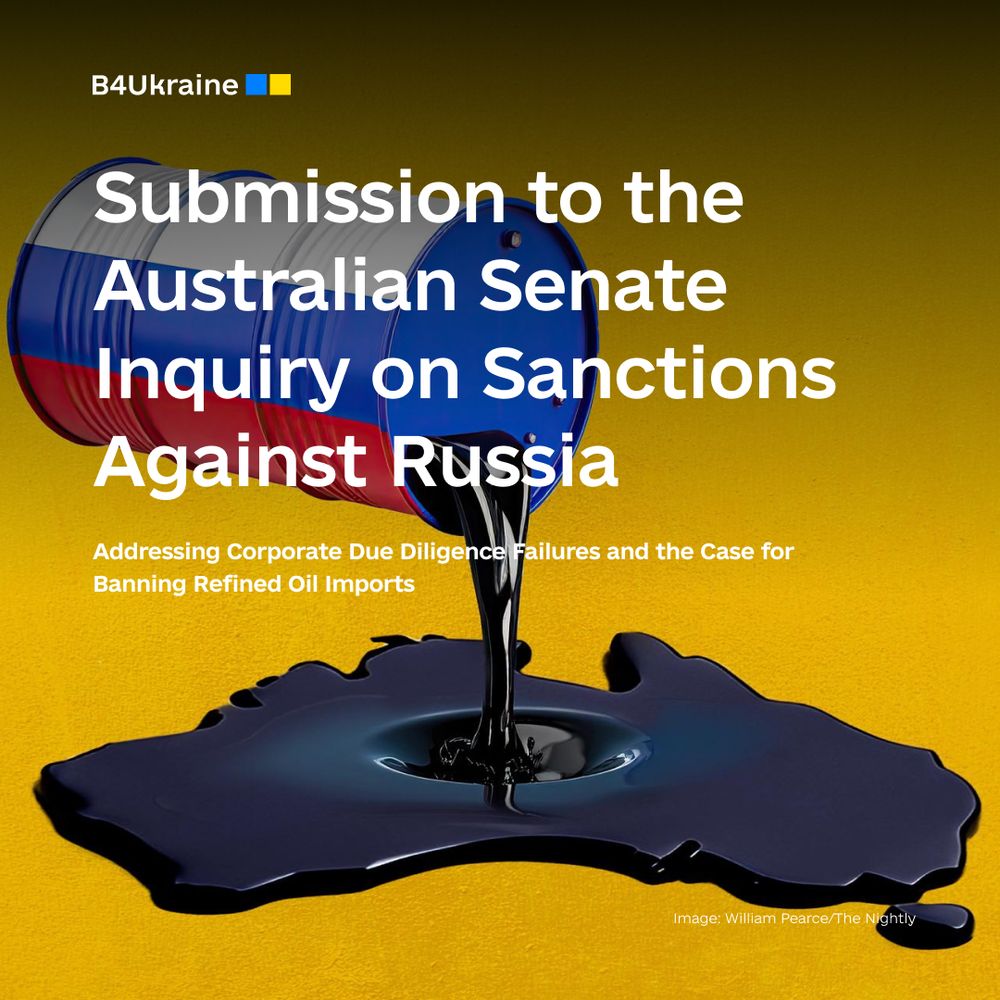


The Australian Senate has accepted B4Ukraine’s submission to its inquiry on the effectiveness of sanctions against Russia. The Senate’s Foreign Affairs, Defence and Trade References Committee is set to report on the inquiry by 20 March 2026.
The purpose of this submission is to support the Australian Senate inquiry into sanctions against Russia by presenting evidence that demonstrates a fundamental failure of voluntary corporate due diligence in the context of Russia’s war against Ukraine. Based on extensive monitoring, data analysis, and direct engagement with multinational companies, B4Ukraine’s findings show that reliance on voluntary standards, self-assessment, and discretionary corporate action has proven wholly insufficient to prevent companies from continuing to operate in, trade with, or financially support the Russian Federation.
Despite clear international standards—most notably the United Nations Guiding Principles on Business and Human Rights—our evidence shows that voluntary corporate due diligence has largely failed in the context of Russia. The overwhelming majority of companies active in or connected to Russia have not undertaken meaningful heightened human rights due diligence, nor have they altered their business practices in ways commensurate with the severity of the conflict. Instead, many companies have treated sanctions compliance as the outer limit of their responsibility, operating within legal and regulatory gaps while continuing to generate revenue for the Russian state.
This failure of voluntary corporate action has direct implications for the effectiveness of Australia’s sanctions regime, including in the current debate on whether Australia should legislate to ban the import of refined petroleum products derived from Russian-origin crude. The continued flow of Russian oil through indirect and opaque supply chains illustrates how corporate reliance on minimal legal compliance and voluntary due diligence undermines the intent of sanctions and allows material support for Russia’s war economy to persist.
As Foreign Minister Penny Wong has emphasised, “Australians do expect that their businesses ensure that their supply chains don’t inadvertently fund Russia’s illegal and immoral invasion of Ukraine.” This submission therefore argues that legislative intervention is necessary. Without clear, enforceable legal obligations—covering due diligence, transparency, and trade prohibitions—Australia’s sanctions framework will remain vulnerable to circumvention through corporate practices that are formally lawful but substantively inconsistent with Australia’s foreign policy, human rights commitments, and support for Ukraine.
1. Analysis: Corporate Due Diligence Failures in Russia Undermine Sanctions and Human Rights Commitments
B4Ukraine’s extensive monitoring, data analysis, and direct outreach to multinational companies reveal a systemic failure of due diligence in relation to ongoing business activity in Russia. These failures are evident in high-risk sectors such as energy, commodities trading, shipping, and refining, which are central to Russia’s fiscal capacity to wage war. Our findings show that:
1.1. Most Companies Are Not Conducting Meaningful Heightened Due Diligence
The United Nations Guiding Principles on Business and Human Rights (UNGPs) require companies to conduct heightened human rights due diligence when operating in conflict-affected areas. However, B4Ukraine’s direct engagement with over 250 companies still active in Russia reveals widespread non-compliance with this obligation. In response to B4Ukraine’s formal requests for disclosure of hHRDD practices, more than 80% of companies provided no meaningful information. Among the limited responses received, only a small fraction demonstrated that the company had undertaken a conflict-sensitive risk assessment. This widespread failure to conduct or disclose hHRDD reflects on the conduct and activities of companies operating in or with the Russian Federation and highlights a critical gap in the effectiveness of existing sanctions frameworks.
In sectors such as oil trading, refining, shipping, and fuel distribution, this lack of due diligence is particularly concerning. Companies frequently rely on the country of last processing rather than the origin of crude oil when assessing risk, allowing Russian-origin oil to be refined in third countries and re-enter global markets as ostensibly “non-Russian” products. This practice reflects a failure to meet heightened due diligence standards in a conflict context.
1.2. Sanctions Compliance Is Not a Substitute for Human Rights Responsibility
Many firms continue to use legal compliance with sanctions as a shield to avoid deeper scrutiny of their operations. In correspondence with B4Ukraine, several companies argued that they had no obligation to exit the Russian market because their operations were not prohibited by law.
This position reflects a fundamental misreading of international standards: sanctions compliance is a floor, not a ceiling, and companies operating in a war economy have obligations that extend beyond what is explicitly banned by governments. Under the UNGPs and OECD Guidelines, businesses must assess whether their activities contribute to or are linked with serious human rights abuses or international crimes, including through complex supply chains.
The import of refined petroleum products derived from Russian-origin crude illustrates this gap starkly. While such imports may be technically legal in the absence of explicit prohibitions, they undermine the purpose of sanctions and allow companies to benefit from legal loopholes while continuing to finance an aggressor state. Australia’s endorsement of the UNGPs makes clear that such conduct is inconsistent with responsible business conduct—yet according to the Centre for Research on Energy and Clean Air (CREA), since February 2023 till the end of June 2025, Australia has imported $6.4 billion in oil products from Indian refineries using Russian crude, with $2.5 billion estimated to be refined directly from it.
1.3. Companies Remaining in Russia Are Contributing to the War Effort
Companies that continue to operate in Russia pay corporate income tax, VAT, payroll tax, and other levies directly into the Russian state budget. Companies remaining in Russia paid at least $20 billion in total tax to Russia in 2024 alone, bringing the total estimated taxes since the full-scale invasion to over $60 billion. This amount is equivalent to nearly half of Russia’s projected military budget for 2025.
Oil and gas revenues remain the backbone of Russia’s fiscal capacity, and refined petroleum products are part of the same revenue stream. Even where oil is sold at a discount or refined abroad, proceeds continue to flow to the Russian state through taxation, export duties, and state-owned enterprises. In a context where over 30% of Russia’s national budget is allocated to military spending, these revenues materially support the purchase of weapons, the operation of the repressive state apparatus, and the continued invasion and occupation of Ukrainian territory.
1.4. Voluntary Standards Are Not Working
Despite early rhetoric from many companies about exiting the Russian market or reassessing their position in Russia, the majority have failed to fully disengage. B4Ukraine’s 2025 monitoring shows that over half of the 1,200 major international companies present in Russia before the full-scale invasion have continued at least some form of operation there, either through direct subsidiaries, local partnerships, or franchising arrangements.
Voluntary commitments, corporate statements, and reliance on reputational pressure have proven insufficient—particularly in sectors with high profit margins and complex supply chains, such as energy and commodities trading.
1.5. These Gaps Undermine the Effectiveness of Australia’s Sanctions
Australia has played a leading role in imposing sanctions on Russia and supporting Ukraine’s sovereignty. However, the continued operation of multinational companies in Russia and the indirect import of Russian-origin products undermine these efforts. It also distorts the competitive landscape for companies that have taken principled steps to exit. Unless the issue of inadequate corporate due diligence is addressed through legal obligations and regulatory oversight, the effectiveness of Australia’s sanctions and its broader human rights objectives will remain incomplete. Australia can help close this accountability gap through targeted legislative action.
2. Recommendations: Strengthening Australia’s Sanctions Regime Through Corporate Due Diligence Reform
To address the risks posed by companies continuing to operate in or with Russia, and to close gaps in Australia’s sanctions and human rights frameworks, B4Ukraine recommends the following actions:
2.1 Support a Legislative Ban on Refined Oil Imports Derived from Russian Crude
Australia should legislate to prohibit the import of refined petroleum products derived from Russian-origin crude oil, regardless of where refining takes place. This measure would close a known sanctions loophole, provide legal clarity for businesses, and align Australia’s sanctions regime with its human rights and international humanitarian law commitments.
2.2 Introduce Mandatory Human Rights Due Diligence for High-Risk Markets
Australia should require companies domiciled or operating in its jurisdiction to conduct heightened human rights due diligence in all conflict-affected and high-risk areas, including Russia. This obligation should be aligned with international standards such as the UNGPs and the OECD Guidelines. The law should require companies to identify, assess, mitigate, and publicly disclose risks of contributing to human rights abuses or international crimes.
2.3 Require Corporate Disclosure of Operations and Tax Contributions in Russia
The government should mandate that companies publicly disclose whether they maintain business operations, subsidiaries, partnerships, or other financial links in Russia. These disclosures should include tax payments made to the Russian state since 2022. Transparency will enable consumers, investors, civil society, and regulators to assess corporate complicity.
2.4 Condition Government Contracts on Responsible Business Conduct
Australia should bar companies that continue to operate in Russia from receiving public procurement contracts, public funding, or participation in trade promotion programs.
2.5 Strengthen Sanctions Enforcement Through Corporate Risk Guidance and Penalties
Australia should develop sector-specific guidance on how sanctions and human rights standards apply to companies operating in or connected to the Russian market. The government should also explore introducing civil and criminal penalties for firms that fail to exit high-risk jurisdictions where their operations contribute to international crimes or human rights harms, even where no direct sanctions breach has occurred.