


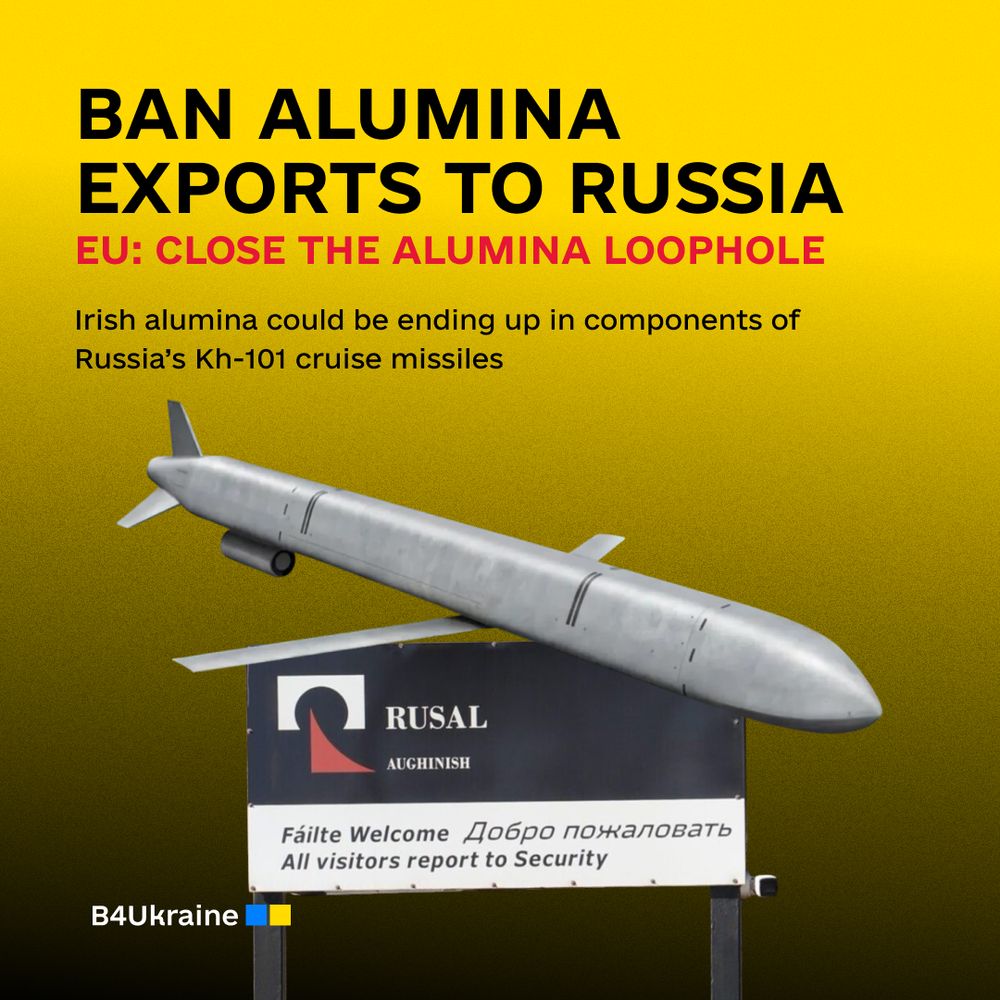


B4Ukraine — an international coalition of more than 100 civil society organisations — calls on the European Union to ban exports of alumina to Russia in the next sanctions package, given the material’s critical importance to Russia’s military-industrial complex and evidence linking Irish alumina to components found in Russian weapons.
The Coalition also urges Ireland, home to Europe’s largest alumina plant currently exporting to Russia, to support the inclusion of alumina in the EU sanctions framework and to champion this measure in its upcoming discussions with the European Commission and fellow member states as it prepares to assume the EU Council Presidency.
EU Council Regulation (EU) No 833/2014 prohibits the export of aluminium to Russia. However, alumina — the primary raw material from which aluminium is smelted — remains entirely outside the scope of these restrictions. This loophole is being exploited by Russia in weapons production supply chains and must be closed immediately.
According to available trade data, direct shipments of alumina from Ireland’s Aughinish Alumina plant under HS code 2818.20 to three Russian RUSAL entities — JSC RUSAL Krasnoyarsk Aluminum Plant, JSC United Company RUSAL Trading House, and PJSC RUSAL Bratsk Aluminum Plant — amounted to 540,497 tonnes, valued at over $307.85 million, between April 2024 and March 2025, according to data compiled by the Economic Security Council of Ukraine (ESCU).
Analysis compiled by ESCU traces a credible supply chain linking this alumina to components of the Kh-101 cruise missile, which has been used extensively by the Russian Air Force in strikes against Ukrainian civilians and civilian infrastructure. The chain runs as follows:
- The Aughinish plant, operated by Limerick Alumina Refining Ltd (LARL), exports alumina from Ireland directly to RUSAL smelting facilities in Russia, including JSC RUSAL Bratsk and JSC RUSAL Krasnoyarsk.
- ASK LLC, a major Russian aluminium distributor, purchases cast aluminium products from these RUSAL entities. Between July 2024 and June 2025, ASK LLC procured over $57.67 million worth of aluminium products from RUSAL Group subsidiaries.
- Since 2022, over 100 Russian defence-sector companies have purchased aluminium from ASK LLC, including 40 entities currently subject to EU sanctions.
- Among ASK LLC’s customers is the P.I. Plandin Arzamas Instrument-Making Plant, which manufactures BDG-1M damping gyroscope units — precision guidance components of the Kh-101 cruise missile. Russian scientific literature confirms that these gyroscope housings are produced using an aluminium alloy casting process.
Although this evidence constitutes a supply chain inference rather than direct proof of end-use, the convergence of trade data, procurement records, and technical specifications establishes a compelling basis for regulatory action.
What do we want decision-makers to do?
European Union:
- Reduce EU dependency on Russian alumina markets and treat alumina as a strategic resource. Russia is one of the main export markets for the Aughinish plant, a situation that persists largely because the plant is RUSAL-owned, with intra-group sales the path of least resistance. The EU should treat alumina as a strategic resource and develop a concrete plan to diversify Aughinish’s export base — toward European industrial users, strategic reserves, or new third-country markets.
- Ban alumina exports to Russia in the next sanctions package. Add alumina (HS code 2818.20) to the list of restricted goods under Council Regulation (EU) No 833/2014, and ensure controls on re-routing via third countries.
Ireland:
- Review export arrangements for the Aughinish plant. The relevant government body should engage proactively at EU level to ensure that the evidence regarding LARL’s shipments informs the ongoing sanctions review process. Since alumina exports to Russia currently require no licence under EU or Irish law, and trade arrangements with third countries being a matter of EU competence — Ireland’s most effective lever is political: ensuring the Commission and Council partners understand the full picture and are pressed to act.
- Scrutinise the 2024 corporate restructuring. Irish authorities should examine whether the transfer of LARL’s ownership from Libertatem Materials Ltd to Libertatem Investments Ltd triggers obligations under foreign investment screening or beneficial ownership transparency frameworks.
Signatories:
- Business for Ukraine (B4Ukraine)
- Economic Security Council of Ukraine (ESCU)
- Independent Anti-Corruption Commission (NAKO)
- State Capture Accountability Project (SCAP)
- The Dekleptocracy Project (DKP)
- International Partnership for Human Rights (IPHR)