


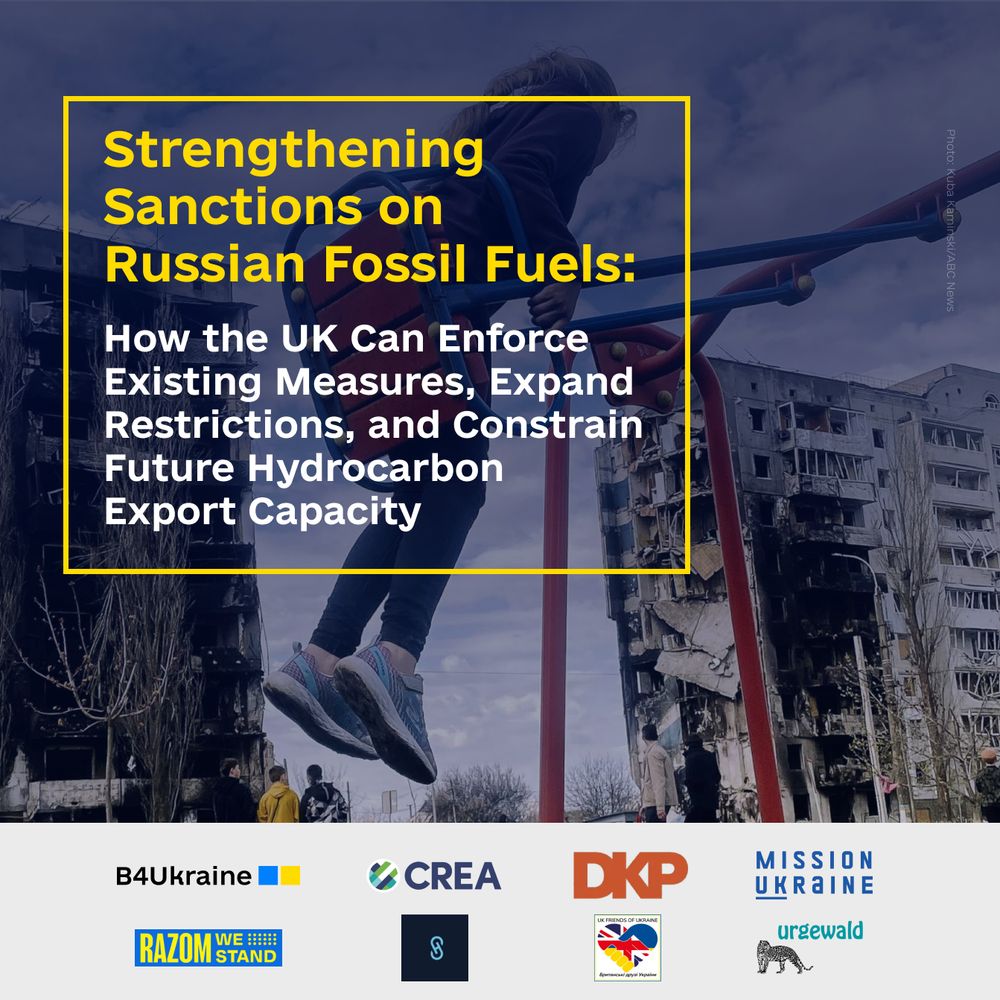


As new Ministers take office, the B4Ukraine Coalition and partner organisations have published a new policy paper outlining practical steps the UK can take to further reduce Russia’s fossil fuel revenues and strengthen sanctions enforcement.
“Strengthening Sanctions on Russian Fossil Fuels: How the UK Can Enforce Existing Measures, Expand Restrictions, and Constrain Future Hydrocarbon Export Capacity” presents a comprehensive set of recommendations designed to reinforce the UK’s sanctions framework across the maritime, energy, and technology sectors.
Despite unprecedented international sanctions, Russia continues to earn substantial revenues from fossil fuel exports by exploiting enforcement gaps, sanctions-evasion networks, maritime service providers, and refining loopholes. The paper argues that the UK is uniquely positioned to address these weaknesses through stronger enforcement and targeted new restrictions.
The recommendations focus on:
- Strengthening enforcement of existing oil sanctions, including the oil price cap and measures targeting the shadow fleet.
- Restricting the maritime services and specialised vessels that enable Russia’s LNG exports and future hydrocarbon expansion.
- Extending maritime sanctions to other strategic exports, including coal.
- Tightening export controls and technology restrictions to limit Russia’s long-term industrial and energy capabilities.
As a global centre for maritime services, insurance, finance, and regulation, the UK has significant leverage over the infrastructure that enables Russian fossil fuel exports. The paper argues that combining more robust enforcement with carefully targeted new measures would increase economic pressure on the Kremlin while making sanctions significantly harder to evade.
The paper was developed jointly by B4Ukraine, the Centre for Research on Energy and Clean Air (CREA), The Dekleptocracy Project, Mission Ukraine, Razom We Stand, Stephen Hoffman Consulting, the UK Friends of Ukraine, and Urgewald.