


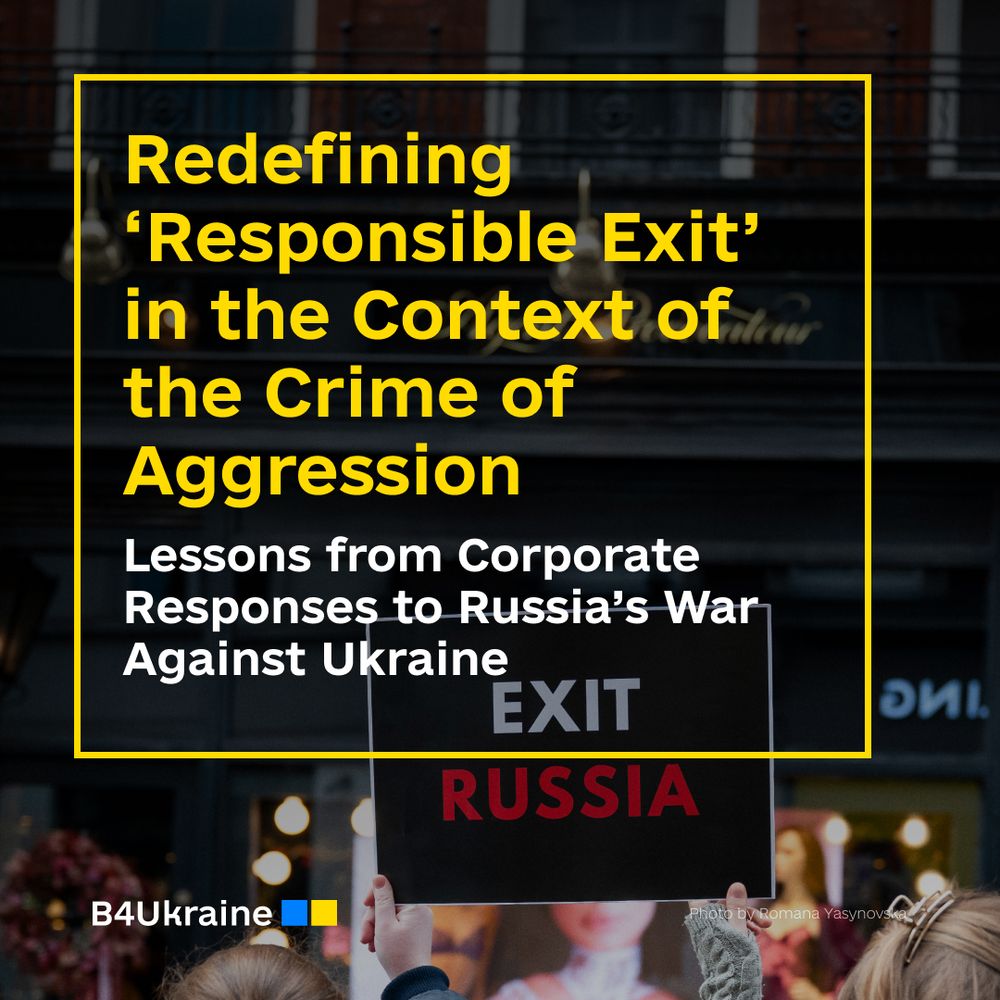


B4Ukraine Coalition outlines framework for corporate disengagement from Russia amid ongoing war against Ukraine
A new report released today by the B4Ukraine Coalition argues that companies operating in states engaged in wars of aggression must move beyond vague commitments and adopt clear, time-bound strategies for responsible disengagement.
Titled Redefining “Responsible Exit” in the Context of the Crime of Aggression – Lessons from Corporate Responses to Russia’s War Against Ukraine, the report provides one of the first comprehensive frameworks for evaluating corporate conduct in the context of an unlawful war.
The paper was developed in collaboration with the Business and Human Rights Centre (BHRC), the Human Rights Centre at the University of Essex, the Kyiv School of Economics (KSE), and the Investor Alliance for Human Rights (IAHR).
Four years after Russia’s full-scale invasion of Ukraine, the authors argue that there is still no widely accepted standard defining what constitutes a “responsible exit” for businesses operating in aggressor states.
“Too much of the debate has focused on whether companies should stay or leave Russia, without addressing how exits should happen, how quickly they should occur, and how companies can avoid contributing to ongoing harm,” the report states.
Grounded in the UN Guiding Principles on Business and Human Rights, international humanitarian law, and analysis of corporate responses since 2022, the report defines responsible exit as a rights-based and time-bound process that prioritises immediate harm reduction and seeks to prevent complicity in international crimes, illustrated through case studies of companies including Unilever, Raiffeisen Bank, and Société Générale.
The report warns that continued economic activity in an aggressor state can sustain the government’s fiscal resources, economic resilience, and technological capabilities — directly or indirectly enabling the continuation of unlawful violence and associated human rights abuses.
“In the context of Russia’s war of aggression, a delayed withdrawal can no longer be viewed as neutral or responsible. Companies that chose to remain after 2022 — and, arguably, after 2014 — made a conscious decision to continue operating in an aggressor state. In doing so, they risk complicity in sustaining the economic structures that enable the war and fall short of the heightened human rights due diligence expected under the UN Guiding Principles. Concerns about consumer convenience cannot outweigh the devastating human cost borne by Ukrainians or the role that continued business operations play in supporting Russia’s capacity to wage war,” said Nina Prusac, a Business and Human Rights Researcher at B4Ukraine.
“The impacts of foreign companies operating in Russia extend far beyond their employees or local communities, as they directly affect Ukrainian civilians. There is no such thing as simply paying taxes in Russia, because those tax contributions are used by the Russian government to produce weapons that kill thousands of civilians in Ukraine. Companies can no longer claim ignorance of the fact that their financial contributions help facilitate war crimes,” said Ella Skybenko, Senior Researcher at the Business & Human Rights Centre.
Among the report’s key recommendations, companies are urged to:
• Conduct heightened, conflict-sensitive human rights due diligence;
• Rapidly suspend or end activities that financially support the aggressor state;
• Avoid transferring assets or capabilities to abusive or state-linked actors during exit processes;
• Provide remedy and support for workers and communities affected by withdrawal.
The report also calls on governments and regulators to strengthen corporate accountability mechanisms, align sanctions and trade policies with human rights standards, and provide clearer guidance for companies operating in conflict contexts. Investors are encouraged to integrate responsible exit expectations into stewardship and investment decisions.