


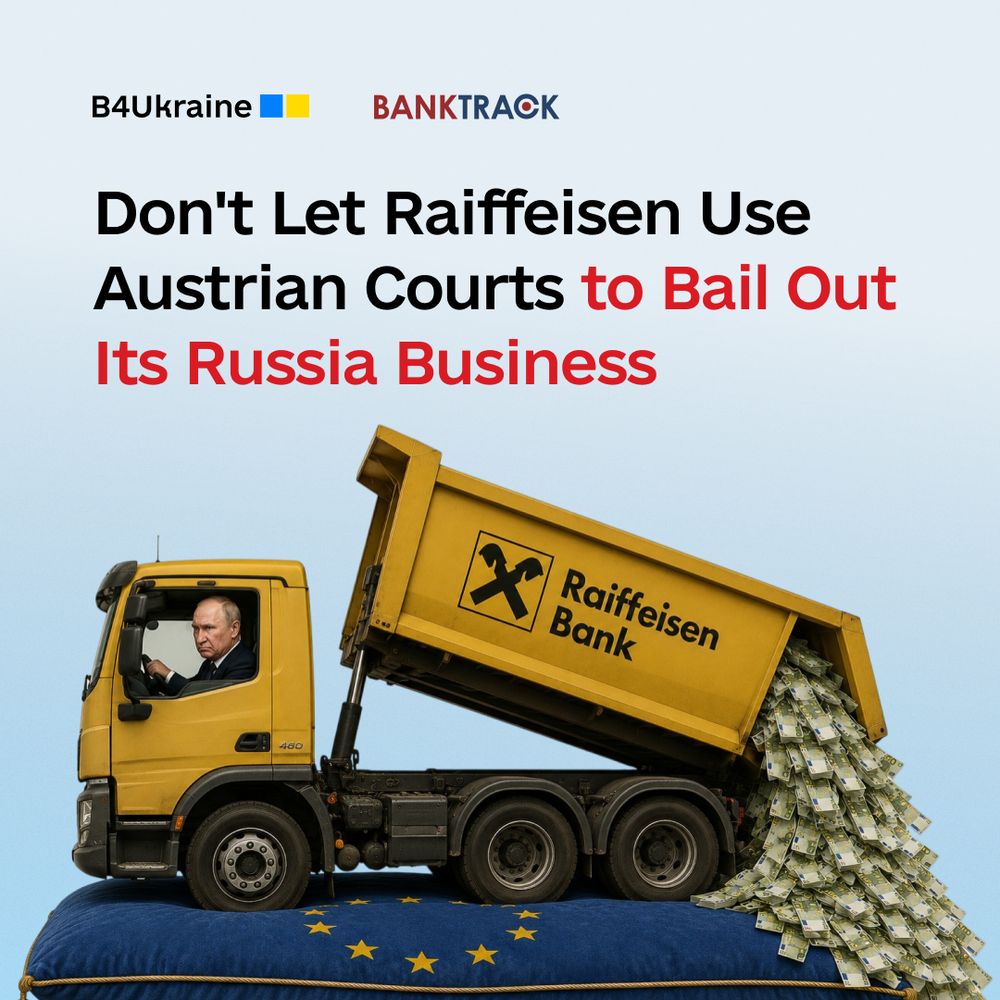


Coalition of civil society organisations denounces Raiffeisen Bank International’s bid to recover €3.15 billion from a Deripaska-linked company as an outrageous scheme that would allow the bank to recoup its Russia losses while continuing to do business in Russia.
Raiffeisen Bank International (RBI) announced last week that it intends to sue sanctioned Russian company Rasperia Trading Limited in Austria for roughly €3.15 billion in damages, in an attempt to enforce a claim on Rasperia’s frozen stake in Austrian construction firm STRABAG that RBI has pursued for nearly three years.
A Russian court had previously blocked Raiffeisen from taking legal action against Rasperia outside Russia, but the block was partially lifted last week, leading RBI’s management to conclude that a “positive outcome” in the case is “highly likely.”
A successful claim would hand the largest international bank still operating in Russia a significant cushion against its losses there – and complete an “asset swap” torpedoed by US authorities over sanctions concerns in 2024.
In late 2023, RBI, facing growing pressures over its continued operations in Russia, had announced a complex scheme intended to help the bank unlock some of its trapped Russian assets. The deal was to involve an “asset swap:” RBI would receive Rasperia’s Austrian STRABAG assets that had been frozen following Russia’s full-scale invasion in Ukraine, while Rasperia would receive €1.5 billion in cash held by RBI’s Russian subsidiary AO Raiffeisenbank that could not be repatriated to Austria.
The deal ultimately collapsed after US regulators intervened over concerns that Rasperia – a company previously owned by sanctioned oligarch Oleg Deripaska – was still effectively connected to Deripaska despite changes in formal ownership. US and European regulators placed Rasperia under sanctions shortly afterwards.
“RBI is essentially asking Austrian courts to revive a sanctions evasion plan that was rightfully tanked by US authorities over two years ago. If the courts approve this claim, they will all but legitimise Deripaska’s attempts to trade his Austrian assets for Russian ones, to oligarchs everywhere that there is a surefire route to avoiding European sanctions,” said Max Hammer, Human Rights Campaigner at BankTrack.
Since the asset swap deal imploded, Rasperia has won two damages claims against RBI in Russian courts — one hearing attended by armed, unidentified men in balaclavas — worth more than €2.3 billion combined and widely viewed as sham rulings. In response, the Austrian government has twice tried and failed to unfreeze Rasperia’s Strabag stake in EU sanctions negotiations in order to award it to RBI to compensate the bank for its losses – proposals that collapsed after opposition from civil society groups and EU diplomats.
If successful, RBI’s most recent damages claim would de facto complete this compensation plan, enabling RBI to swap its lost assets in Russia via far more valuable Austrian assets. Austrian courts would also de facto enforce a Russian court verdict on Austrian soil – an unprecedented step – by ruling in line with the Russian court which first imposed damages on RBI in Russia. That court had ruled that Rasperia’s STRABAG stake was to be handed over to RBI in Austria in order to complete the proposed asset swap, a ruling that was previously not enforceable in Europe.
As BankTrack and B4Ukraine warned alongside 15 other global civil society organisations in late 2025, enforcing this ruling would risk “signal[ling] to Russian oligarchs that they have a viable path towards recuperating their frozen assets in Europe by seizing European assets in the Russian courts.”
Concerns about Rasperia’s ownership structure also remain pertinent. Swedish authorities recently ruled that Russian aluminium company Rusal remains under Deripaska’s effective control despite changes in ownership structure. If Deripaska similarly retains effective control over Rasperia, as US sanctions authorities allege, this could complicate RBI’s attempts to enforce its claims over the sanctioned STRABAG assets, which would need to be unfrozen before being transferred to RBI.
“For almost three years, RBI has tried to free up capital in Russia through backdoor deals with Russian shell companies. Previous rulings on its dealings with Rasperia underscore the risks of doing business with any company tied to sanctioned oligarchs. RBI must finally quit Russia once and for all – and, if it recoups money from Rasperia, that money should go straight to Ukraine as reparations for the bank’s continued ties to the Russian war machine,” said Nezir Sinani, Executive Director at B4Ukraine.