


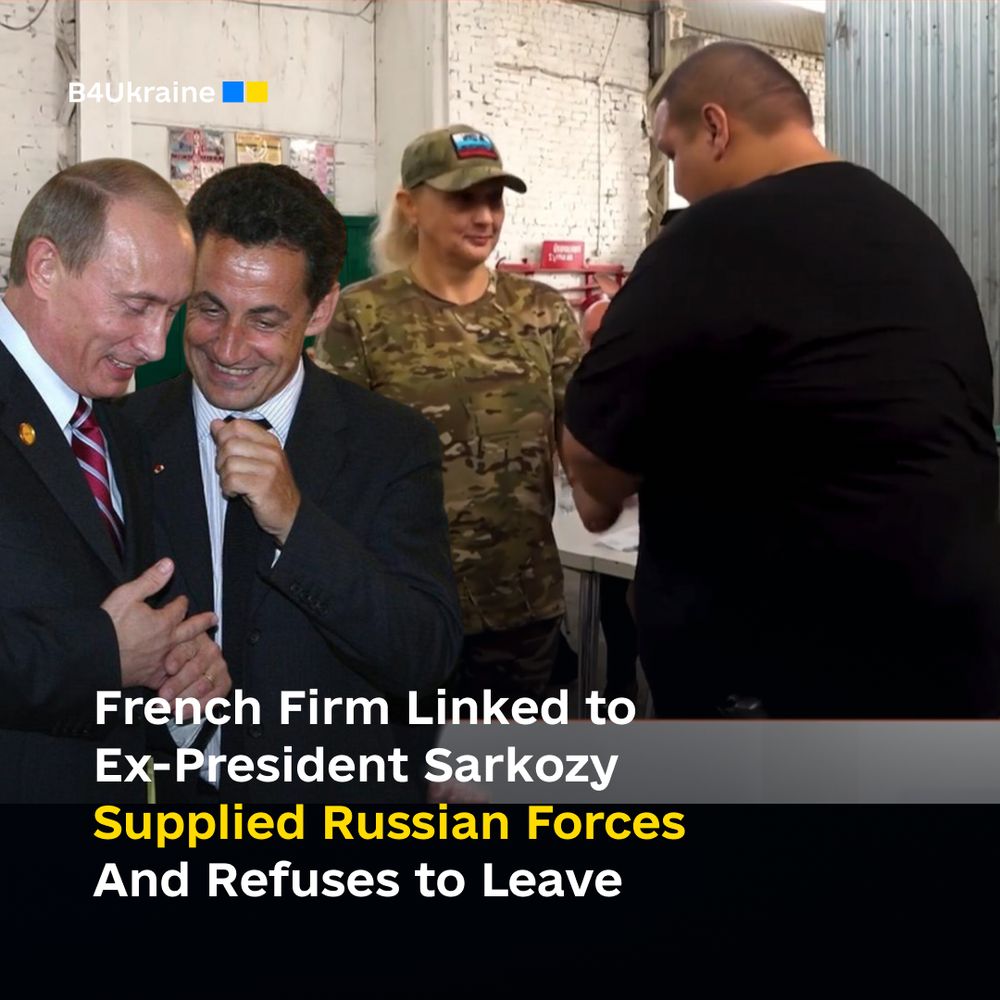


“Heroes and soldiers just like those on the front line” — that’s how a military officer involved in Russia’s illegal invasion of Ukraine described employees of an enterprise owned by the French company Sucden, as he thanked them for support and presented them with medals.
Sucden’s headquarters claims it complies with EU sanctions and was unaware that its numerous Russian subsidiaries were supplying the military with materials and equipment and donating to support the killing of Ukrainians.
Sucden’s response is a template that allows Western companies to use sanctions compliance as an excuse to remain in the aggressor state and avoid accountability for enabling its war effort. Sanctions compliance has become the respectable face of continued war complicity and profiteering.
What does Sucden do?
Sucden (Sucres et denrées) is a sugar giant whose consultant is the former French president Nicolas Sarkozy. In Russia, Sucden is recognized as one of the country’s top sugar producers.
The company directly manages around 250,000 hectares of arable land and cultivates a range of crops, including sugar beet, wheat, barley, sunflower, peas, and corn, while also processing them at four sugar plants with a combined sugar production capacity approaching 800,000 metric tons annually. According to the Kyiv School of Economics, Sucden’s revenue in Russia in 2024 amounted to $25 million.
Medals for the factory floor
According to an investigation published in February, several Russian subsidiaries of Sucden provided the military with machines and materials for weaving camouflage nets, rubber strips to protect armored vehicles from drones, anti-drone blankets, vehicles, and also donated to the units fighting against Ukraine.
For instance, Sucden’s Atmis-Sakhar sugar plant reportedly manufactured ovens for the military, supplied rubber conveyor belts, and also opened a workshop for producing camouflage nets.
The report also describes a case in 2024 when a fighter from the “Bars” unit, Alexander Koklin, visited Sucden’s enterprise Uspensky Agropromsoyuz and presented its employees with 25 medals in gratitude for their support, calling them “heroes and soldiers just like those on the front line.”
From compliance to complicity
In response to an inquiry from the B4Ukraine Coalition, Sucden said that these events “were previously unknown to Sucden’s headquarters” and that it had issued “instructions locally to ensure that such events shall not occur within Sucden subsidiaries.” The company did not respond to B4Ukraine’s call to halt all investments in Russia and fully exit the Russian market.
Instead, Sucden emphasized that since 2022, it has implemented a compliance framework to ensure adherence to obligations imposed by the European Union on EU-based companies with subsidiaries in Russia.
Companies often use sanctions compliance as a pretext to continue operating in aggressor states such as Russia. Compliance with sanctions, however, does not replace responsible business conduct and other obligations under the UN Guiding Principles on Business and Human Rights (UNGPs).
Sucden has clearly failed to adequately address the human rights risks linked to its ongoing operations in Russia, and its subsidiaries’ activities supporting the Russian Armed Forces could be considered aiding an entity committing war crimes and crimes against humanity.
Political cover
Sucden’s case also shows that companies with political cover at the highest level don’t feel pressure to leave. Mediapart notes the role of the former French President Nicolas Sarkozy, who works with Sucden as a consultant and is also a friend of the family of its owner, sugar magnate Serge Varsano.
The outlet has previously detailed Sarkozy’s business and political ties in Russia, as well as his consultancy contracts with Russian companies. The former president reportedly received two payments from Russian sources totaling 300,000 euros for speaking at a 2018 event hosted by the Russian Direct Investment Fund. In his speech, Sarkozy praised Russia and Vladimir Putin.
A juicy target
Russia is a strategically important country for Sucden, as the group’s main production cluster is located there. Although the Russian subsidiaries account for only 7% of the group’s revenues, they employ 4,300 people — nearly 80% of the company’s total workforce.
After an investigation into Sucden units’ support for the Russian army was published, Russian media reported that Gazprombank was allegedly interested in acquiring both a stake in the group’s Russian subsidiary and its entire business in Russia. Etienne Pelletier, CEO of Sucden’s Russian unit, denied the reports, saying the company has no intention of leaving Russia or selling its operations in the country.
However, as Moscow moves further away from the rule of law, the Russian government already effectively controls the assets of foreign businesses that remain in the country, making the risk of expropriation for Western companies — even those expressing no intention of leaving — higher than ever.
The piece was originally published in Euromaidan Press