


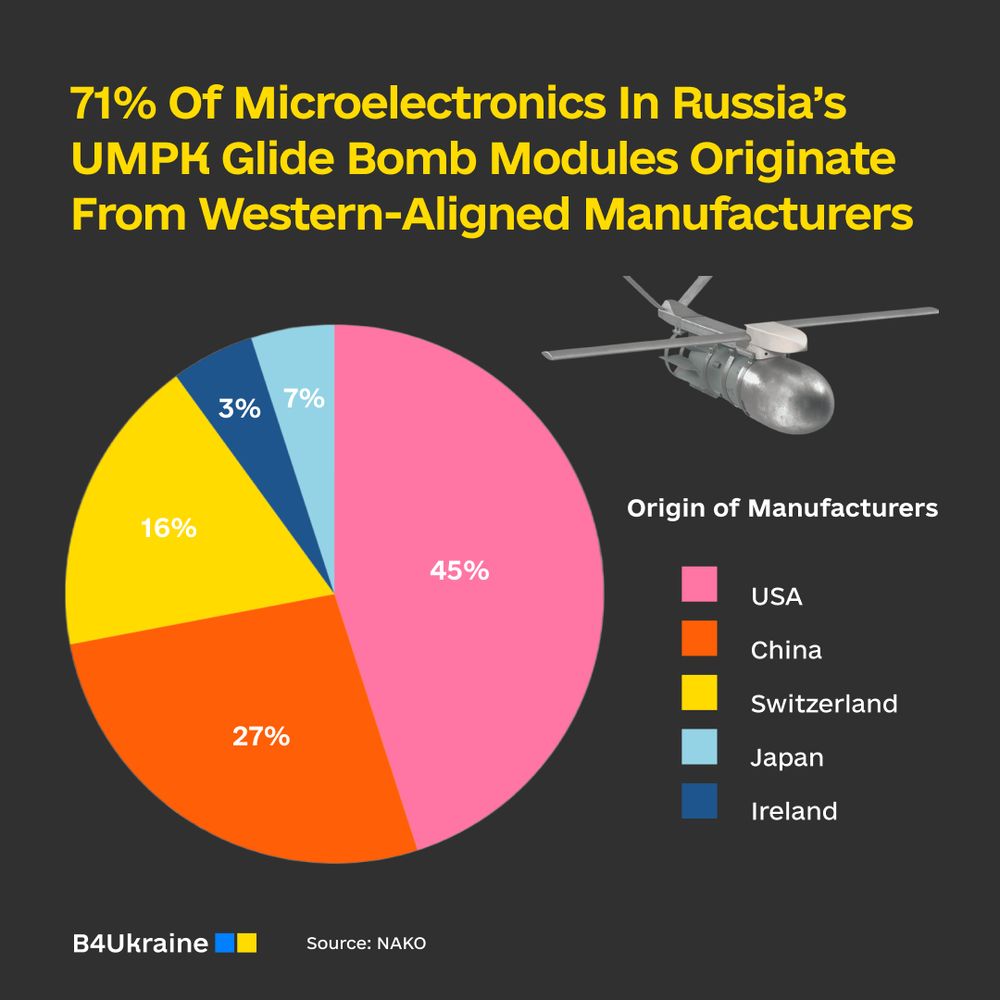


Components produced by Western companies, including Texas Instruments, Intel, and Irish antenna manufacturer Taoglas, have been recovered from the debris of Russian glide bombs used to terrorize Ukrainian cities.
These weapons — equipped with Russia’s Universal Planning and Correction Module (UMPK), a guidance kit that converts Soviet-era “dumb bombs” into precision-guided munitions — rely heavily on foreign microelectronics to strike targets as far as 200 km from the front line.
Who’s sanctioning whom — and who isn’t
Behind Russia’s ability to produce UMPK at scale lies a single structural failure: the global sanctions regime is fragmented and inconsistent. In a recently completed investigation, the Independent Anti-Corruption Commission (NAKO) documented 26 factories involved in manufacturing various UMPK components — a number that continues growing as Russia expands production capacity.
Sanctions often fail to target the same entities—different jurisdictions impose restrictions on different companies, creating exploitable gaps in the global enforcement framework
As of last year, Ukraine has sanctioned 85% of these component producers, the United States has sanctioned 73%, the European Union and Switzerland have restricted just over 50%, and the United Kingdom has sanctioned a mere 7%.
Moreover, these sanctions often fail to target the same entities — different jurisdictions impose restrictions on different companies, creating exploitable gaps in the global enforcement framework.
States where the manufacturers of components used in Russian glide bombs are based or incorporated must strengthen sanctions enforcement, align their sanctions regimes, investigate supply chains, and ensure compliance with export controls to prevent the flow of essential technologies into Russian hands.
What’s special about the Russian glide bomb?
Russia’s use of glide bombs has changed the course of the war, and Ukraine still lacks a way to counter them effectively.
The widespread deployment of glide bombs by Moscow started in late 2023.
The Russian military industry developed a kit that, when attached to a standard unguided free-fall bomb (of which Russia has a nearly unlimited stockpile since Soviet times), converts it into a guided, high-precision glide munition. This kit is known as a Universal Planning and Correction Module (UMPK).
These bombs are very difficult to intercept and they are much cheaper and more abundant than missiles
UMPK also dramatically extended the range at which aerial bombs can be used, allowing Russian bombers to operate without entering Ukraine’s air defense zones and drop bombs from well behind the front lines.
These bombs are very difficult to intercept; they are much cheaper and more abundant than missiles, while their several hundred kilograms of explosive can destroy front-line fortifications.
In January 2026, the use of glide bombs hit a new monthly record, with over 5,700 dropped — a 26% increase compared to December 2025.
Glide bombs now threaten cities far from the front lines
The bombs are being used against cities close to the front lines. In Sumy Oblast, they are employed to create “buffer zones” by systematically leveling border villages and striking logistics hubs. Sumy has experienced a sharp increase in strikes from FAB-3000 bombs — three-ton behemoths that require UMPK kits and cause massive destruction.
In Zaporizhzhia, glide bombs quickly became the dominant weapon after September 2024; by early 2025, they were responsible for the majority of civilian casualties in the city. Odesa witnessed its first-ever glide bomb attack in October 2025.
With the ongoing development of extended-range UMPK variants, glide bombs now threaten cities far from the front lines.
Western tech fueling Russian destruction
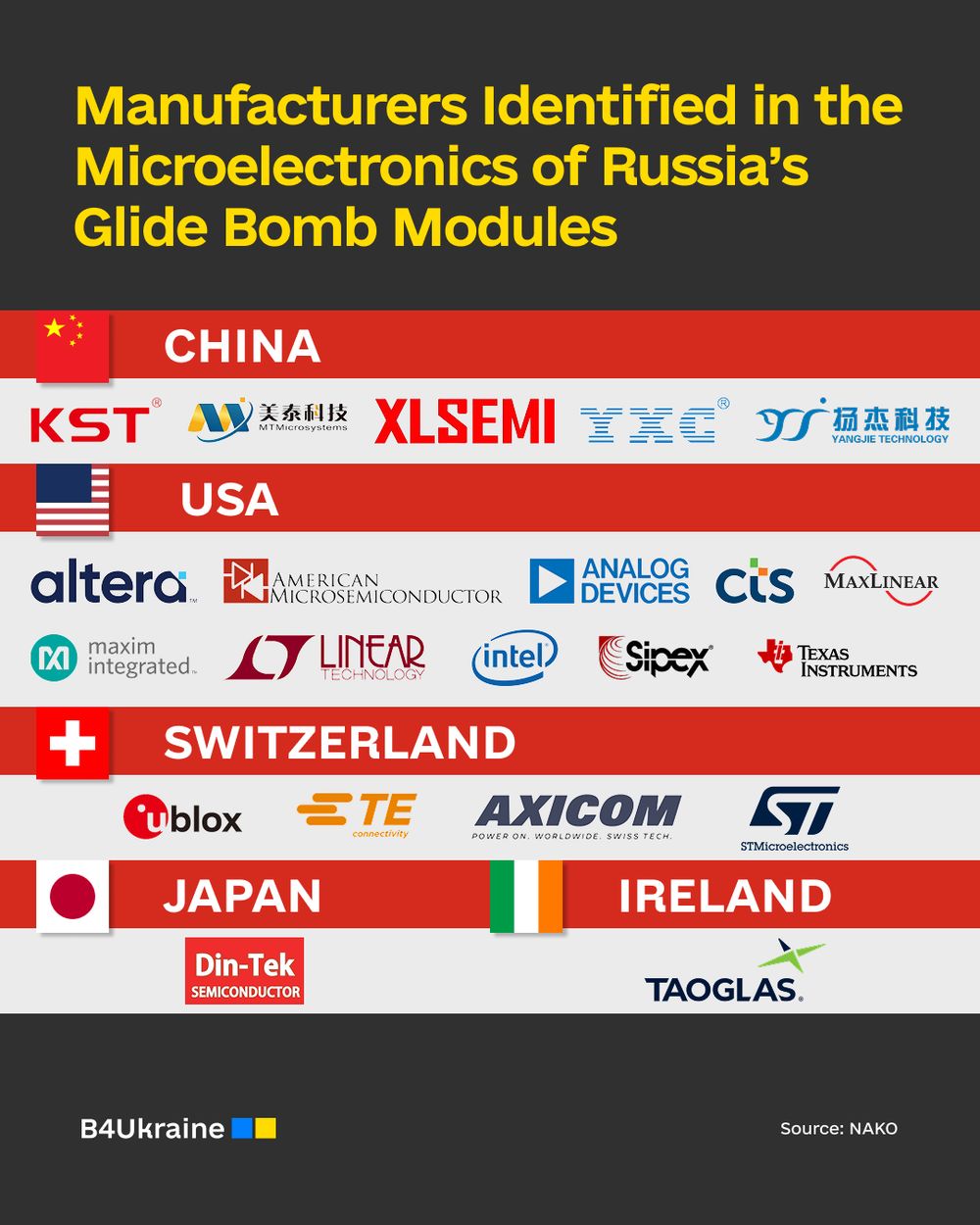
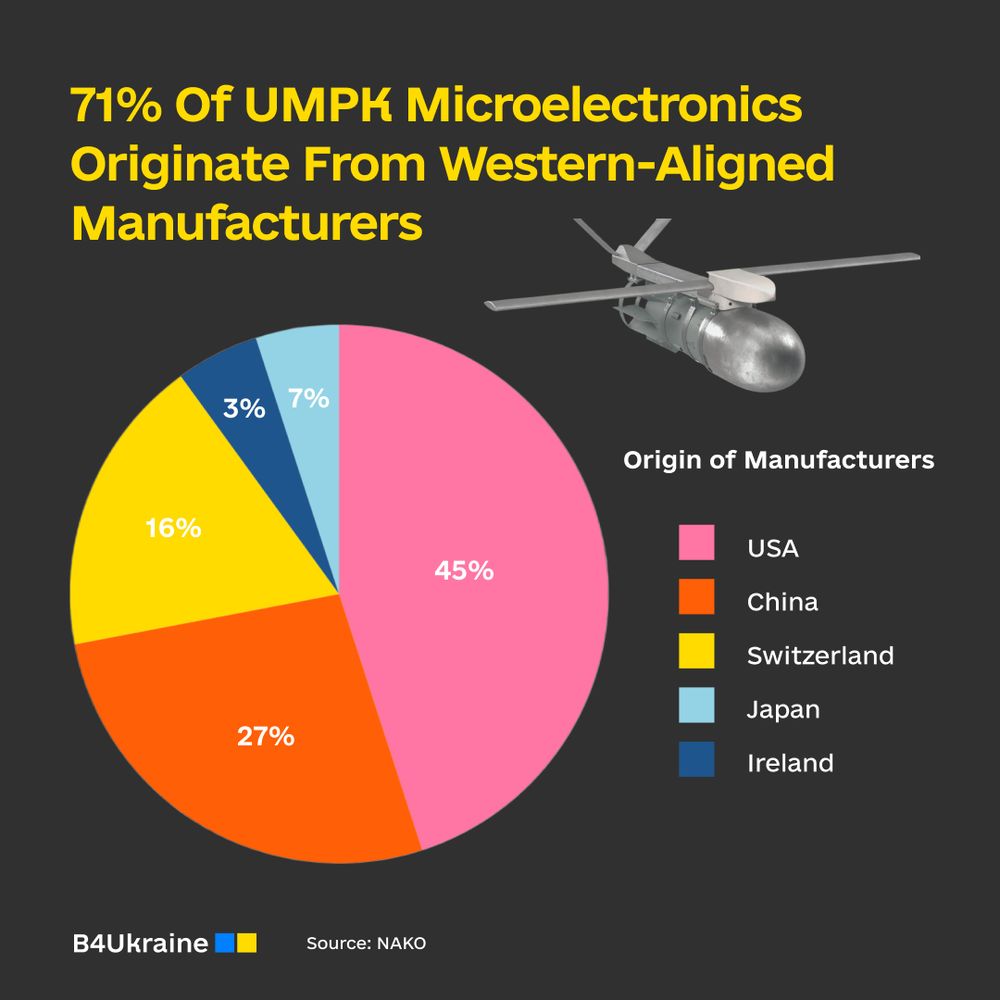
According to NAKO, about 71% of the microelectronics used in UMPK modules originate from manufacturers based in Western-aligned countries. Of the 22 identified manufacturers, ten are from the US, six from China, four from Switzerland, and two each from Ireland and Japan.
NAKO’s investigation found that China and Hong Kong-based companies accounted for over 82% of prioritized goods shipments to Russia.
NAKO’s investigation — which examined UMPK debris recovered from strike sites and analyzed over 600,000 customs records of electronic component shipments — found that China and Hong Kong-based companies accounted for over 82% of prioritized goods shipments to Russia, valued at over $1.5 billion.
Secondary hubs like Turkey, Serbia, and the United Arab Emirates help route components around trade restrictions.
The sanctions gap must be plugged
The key problem is inconsistent sanctions across jurisdictions. Many companies find themselves sanctioned by only one or two of the three major jurisdictions (EU, US, Ukraine), allowing them to continue operations through unsanctioned pathways.
Every gap left open is a channel through which components flow into Russian production lines.
Closing those channels requires concrete steps, and building authorities’ capacity to detect violations through cross-border information sharing
Closing those channels requires concrete steps: targeting intermediaries and transshipment hubs, applying consistent sanctions on military-related entities across all jurisdictions, and building authorities’ capacity to detect violations through cross-border information sharing with governments and civil society.
Manufacturers and dealers of components identified in UMPK debris should also implement robust Know Your Customer systems and red-flag assessments to cut off the networks keeping Russia’s war machine supplied.
Western technology will keep powering the weapons devastating Ukrainian cities for as long as gaps remain
The data is unambiguous: where governments have acted, they have restricted the majority of known producers. Where they haven’t — the UK’s 7% tells its own story — the supply chains stay open. Western technology will keep powering the weapons devastating Ukrainian cities for as long as those gaps remain.
The piece was originally published in Euromaidan Press